How to Check and Top Up Car Fluids: Complete Maintenance Guide
Your car runs on five essential fluids: engine oil, coolant, brake fluid, power steering fluid, and windscreen washer fluid. Low or contaminated fluids cause the majority of preventable breakdowns, yet checking them takes just 10 minutes monthly. Most people never look under their bonnet until something goes catastrophically wrong.
RAC maintenance guidelines recommend checking all vital fluids monthly to prevent breakdowns and expensive repairs, most fluid issues are easy to spot and fix yourself. Yet simple neglect turns £10 top-ups into £500+ repair bills when engines overheat, brakes fail, or power steering pumps seize.
This complete guide How to Check and Top Up Car Fluids shows you exactly where to find each fluid reservoir, how to check levels correctly, when to top up, and what fluid to use. You’ll learn warning signs of leaks or contamination, safety precautions, and which issues require professional attention versus simple DIY fixes.
By the end, you’ll have the knowledge and confidence to perform this essential 10-minute monthly check, potentially saving thousands in avoided repairs and preventing dangerous breakdowns. Let’s keep your car running safely and reliably.
What You’ll Need
Essential items:
- Owner’s manual (identifies reservoir locations and correct fluid types)
- Kitchen roll or clean cloth
- Torch or phone light (see reservoir markings clearly)
- Funnel (for topping up without spills)
- Gloves (optional but cleaner)
- Fluids to keep on hand:
- Engine oil (correct grade for your car) – £15-25 for 5L
- Coolant/antifreeze (pre-mixed or concentrate) – £10-15 for 5L
- Brake fluid (DOT 4 most common) – £5-10 for 1L
- Power steering fluid (if not electric steering) – £5-10 for 1L
- Windscreen washer fluid – £3-5 for 5L
Total investment:
- £40-60 (lasts 1-2 years for occasional top-ups)
Safety Precautions (Read First)
Before checking fluids:
- Park on level ground (slopes give false readings)
- Apply handbrake
- Turn off engine and remove key
- Let engine cool 10-15 minutes (prevents burns from hot coolant/oil)
- Exception: Some oil checks require warm engine, check manual
Never:
- Open coolant reservoir when engine is hot (pressurized boiling liquid can spray)
- Touch engine components immediately after running
- Smoke near battery or fuel system
- Mix different types of brake fluid
- Overfill any reservoir (causes pressure issues)
Engine Oil (Check Every 2 Weeks)
Why it matters:
- Engine oil lubricates moving parts, reduces friction, and prevents catastrophic engine damage. Running low destroys engines costing £2,000-5,000 to replace.
How to check:
- Park on level ground, turn off engine
- Wait 5 minutes for oil to drain into sump
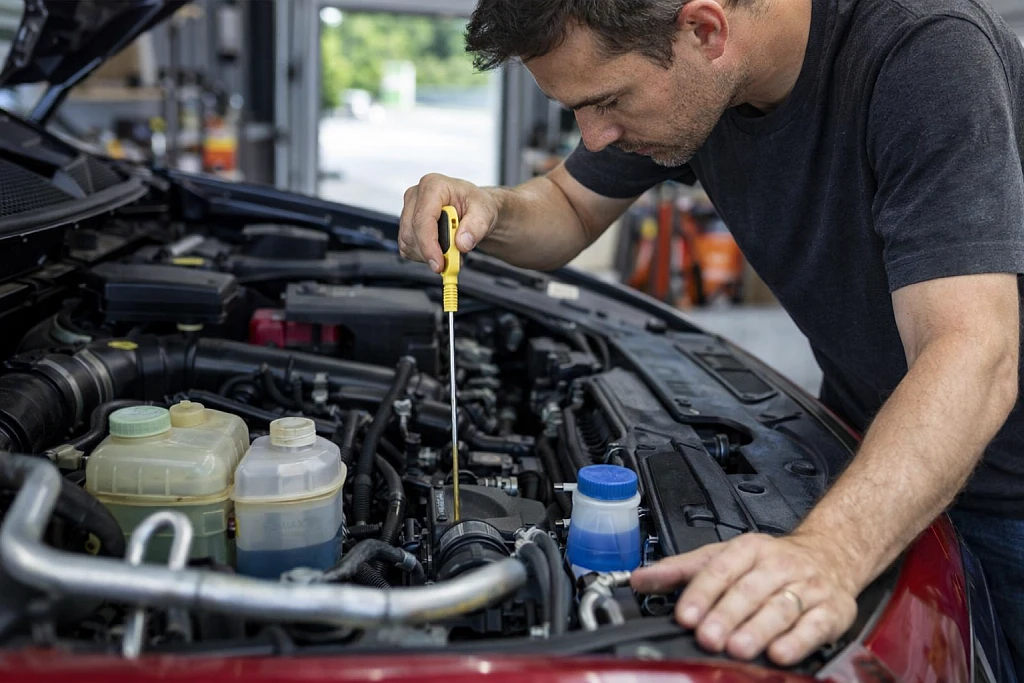
- Locate dipstick (usually has yellow/orange loop handle, labeled ‘Engine Oil’)
- Pull dipstick out completely
- Wipe clean with cloth
- Reinsert fully until seated
- Pull out again and read level
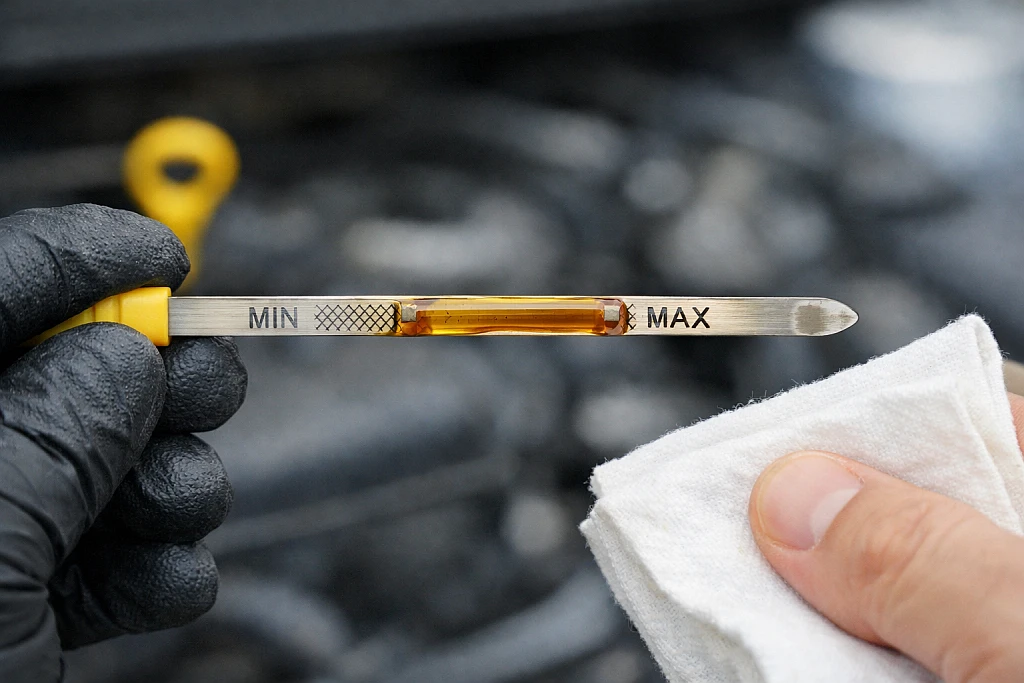
- Oil should be between MIN and MAX marks
What you’re looking for:
- Level: Between MIN and MAX (closer to MAX is ideal)
- Colour: Light golden brown (new) to dark brown (due for change)
- Texture: Smooth, not gritty or sludgy
- Smell: Normal oil smell, not burnt or petroly
How to top up:
- If oil is below halfway mark or near MIN:
- Locate oil filler cap (usually on top of engine, labeled ‘Oil’)
- Remove cap
- Add small amount (100-200ml) using funnel
- Wait 2 minutes for oil to settle
- Recheck dipstick
- Repeat until level reaches MAX (don’t overfill)
- Replace oil cap securely
Warning signs:
- Oil consistently low between changes: Leak or burning oil (check for blue exhaust smoke)
- Black, thick, or sludgy: Overdue for oil change
- Milky or frothy: Coolant leak into oil (head gasket failure, serious)
- Smell of petrol: Fuel contamination (don’t drive, call garage)
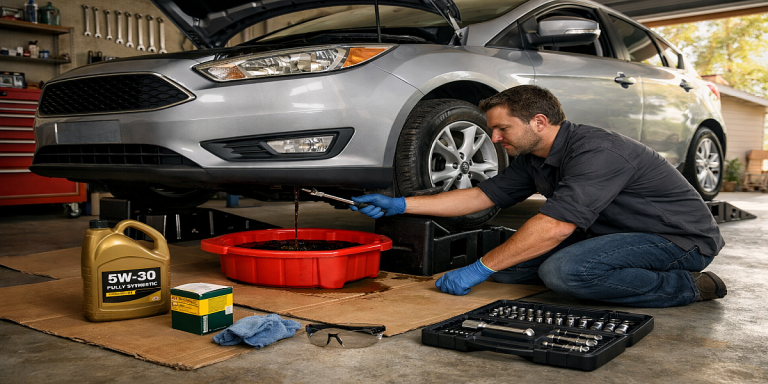
- If your engine oil is consistently low or very dark between services, it’s time for a full change, follow our complete oil change guide to do it yourself and save money.
Coolant/Antifreeze (Check Monthly)
Why it matters:
- Coolant prevents engine overheating (can warp cylinder head, £1,000+ repair) and freezing in winter. Low coolant causes overheating and catastrophic engine damage.
How to check:
- CRITICAL: Only check when engine is completely cold
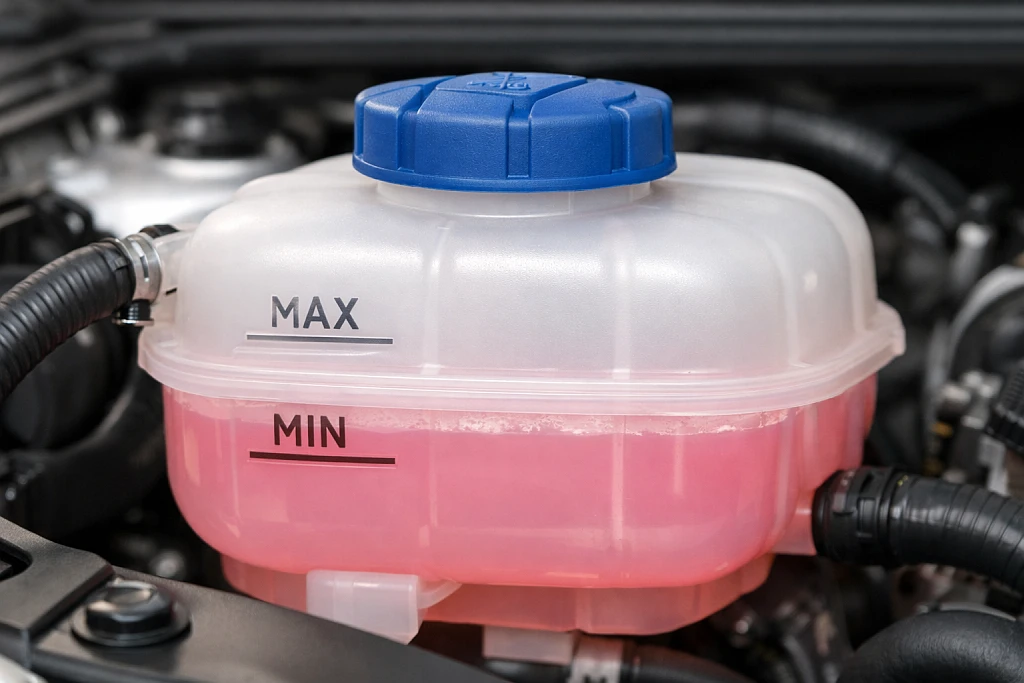
- Locate coolant expansion tank (translucent plastic, usually near radiator)
- Tank has MIN and MAX marks on side
- Look at fluid level through translucent tank (don’t open cap yet)
- Level should be between MIN and MAX
- Cold engine: Level near MIN is normal
- Warm engine: Level rises toward MAX (thermal expansion)
What you’re looking for:
- Level: Between MIN and MAX
- Colour: Usually pink, green, yellow, or blue (depends on antifreeze type)
- Clarity: Should be transparent, not murky or rusty
- No oil contamination (rainbow sheen on surface)
How to top up:
- WAIT until engine is completely cold (at least 2 hours after driving)
- Cover cap with cloth and slowly unscrew (releases any residual pressure)
- Remove cap fully only when no pressure remains
- Add 50/50 mix of antifreeze and distilled water (or buy pre-mixed)
- Fill to MAX mark
- Replace cap securely
- Run engine and recheck level after 5 minutes (may drop as air purges)CRITICAL: Antifreeze types are not universally compatible
- Check manual for correct type (OAT, IAT, or HOAT)
- Mixing incompatible types creates gel that blocks cooling system
- If unsure, use universal antifreeze or drain and refill completely
Warning signs:
- Consistently low: Leak (check under car, around radiator, hoses)
- Sweet smell from engine: Coolant leak (glycol smell)
- Rusty or brown colour: Corrosion in system (needs flush)
- Oil in coolant: Head gasket failure (expensive repair)
- Temperature gauge reading high: Insufficient coolant or thermostat fault
Brake Fluid (Check Every 2 Months)
Why it matters:
- Brake fluid transfers force from brake pedal to brake pads. Low fluid means reduced braking power or complete brake failure. This is a critical safety system.
- Low brake fluid is an automatic MOT test failure, keeping fluid at proper levels isn’t just about safety, it’s a legal requirement to keep your car roadworthy.
How to check:
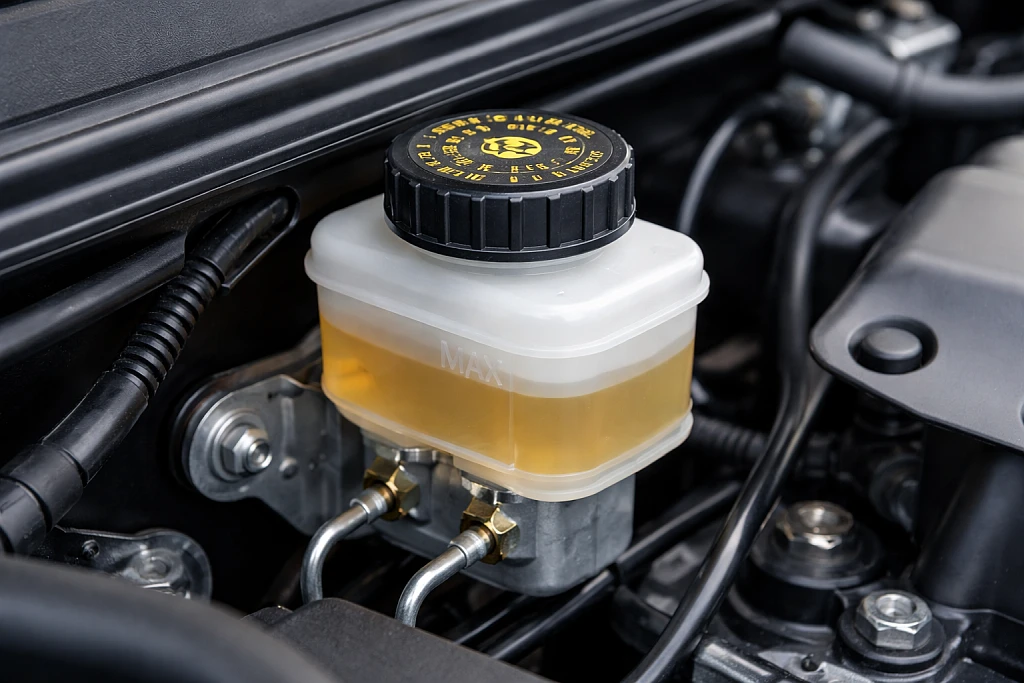
- Locate brake fluid reservoir (usually on driver’s side, near firewall)
- Translucent plastic tank with MIN and MAX marks
- Check level without opening cap (contamination risk)
- Level should be near MAX (drops slightly as brake pads wear)
- Clean area around cap before opening to prevent dirt entering
What you’re looking for:
- Level: Between MIN and MAX (closer to MAX is normal)
- Colour: Clear to light amber when new, darkens with age
- Clarity: Should be transparent, not cloudy
- No sediment or particles
How to top up:
- Wipe cap and surrounding area completely clean
- Remove cap carefully (don’t let dirt fall in)
- Use ONLY the specified brake fluid type (usually DOT 4, check cap/manual)
- Add slowly to MAX mark
- Replace cap immediately (brake fluid absorbs moisture from air)
- Don’t overfill (no space for thermal expansion)
CRITICAL: Brake fluid hygiene
- Brake fluid is hygroscopic (absorbs water from air)
- Water contamination reduces boiling point (brake fade)
- Open bottle for shortest time possible
- Discard opened bottles after 12 months
- Never mix DOT 3, DOT 4, and DOT 5 (DOT 5 is silicone-based, incompatible)
Warning signs:
- Rapidly dropping level: Brake leak (URGENT, don’t drive)
- Dark brown or black: Contaminated (needs complete flush)
- Slowly dropping over months: Normal (pads wearing, check pads)
- Spongy brake pedal: Air in system (needs bleeding)
- Low pedal/pedal goes to floor: Critical leak or worn pads
Power Steering Fluid (Check Every 2 Months)
Note: Many modern cars use electric power steering (no fluid)
Check your manual, if it has electric power steering, skip this section.
Why it matters:
Power steering fluid enables easy steering. Low fluid causes stiff steering, whining noise, and potential pump damage (£300-600 repair).
How to check:
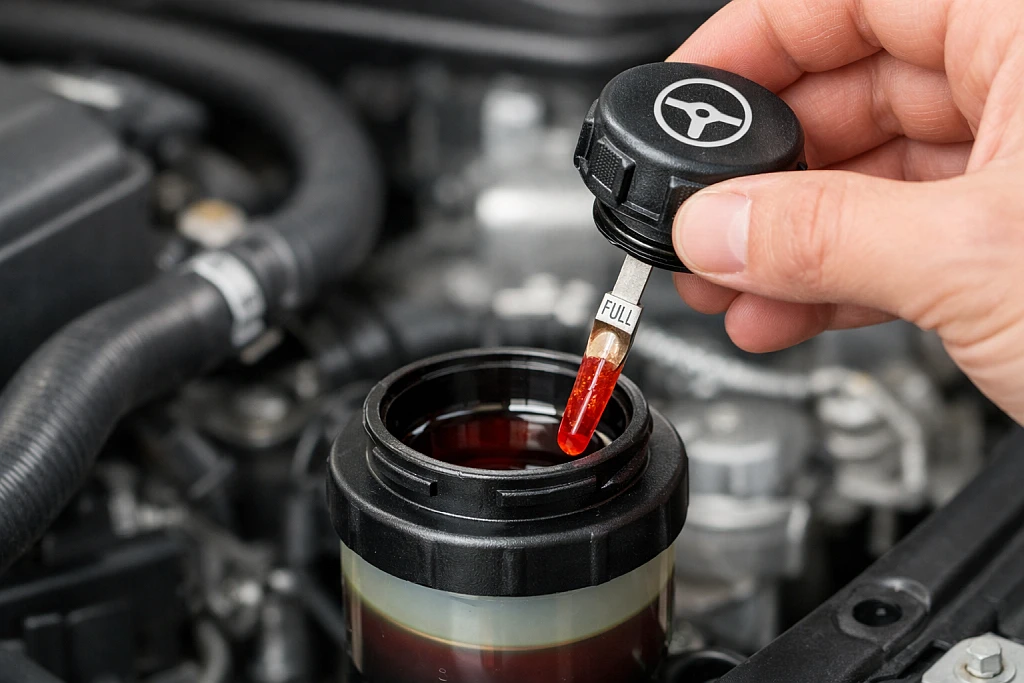
- Locate reservoir (usually small tank near engine, labeled ‘Power Steering’ or steering wheel symbol)
- Some have dipstick attached to cap, others have transparent reservoir with markings
- Check when engine is cold (some systems specify warm, check manual)
- If dipstick type: Remove, wipe, reinsert, remove and read
- If transparent: Read level through side
- Level should be between MIN and MAX
What you’re looking for:
- Level: Between MIN and MAX
- Colour: Usually red or clear (depends on type)
- Not burnt smell
- No metal particles or debris
How to top up:
- Use ONLY specified fluid type (check cap or manual, ATF, PSF, or specific brand)
- Remove cap and add slowly
- Fill to MAX mark
- Replace cap securely
- Start engine, turn wheel lock-to-lock 2-3 times
- Recheck level (may drop as fluid circulates)
Warning signs:
Whining noise when turning: Low fluid or pump wearing out
Heavy steering: Very low fluid or pump failure
Fluid consistently low: Leak in system (check hoses, rack, pump)
Dark/burnt fluid: Overheated (needs flush and system check)
Windscreen Washer Fluid (Check Monthly)
Why it matters:
Clean windscreen is essential for safe driving. Empty washer bottle means you can’t clear dirt, insects, or road spray, dangerous and illegal to drive with obscured vision.
How to check:
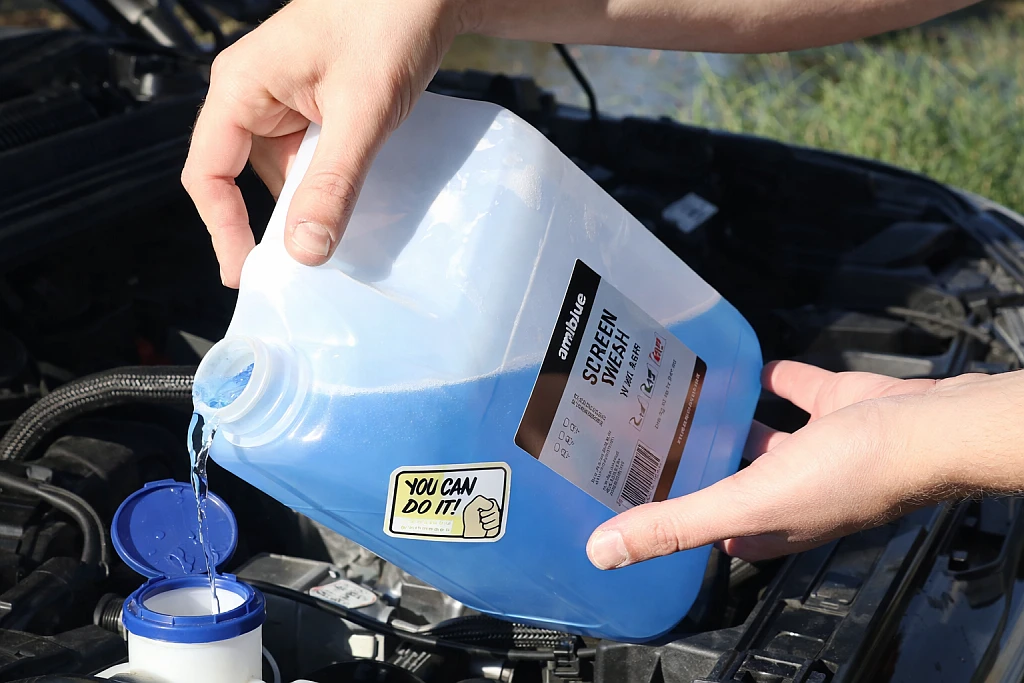
- Locate washer reservoir (usually largest plastic tank, blue or white cap with windscreen symbol)
- Most don’t have level markings, just look inside with torch
- Should be at least half full
- Easiest fluid to check, no precision needed
How to top up:
- Remove cap
- Use screenwash concentrate mixed with water (follow bottle ratio)
- OR use pre-mixed screenwash (more expensive but convenient)
- Fill until you can see fluid near top
- Don’t use washing-up liquid (damages paintwork and smears)
- In winter: Use antifreeze screenwash to prevent freezing
Winter tip:
- Frozen washer fluid is common problem
- Use winter/all-season screenwash (protects to -20°C)
- If frozen: Park in warm garage or pour lukewarm water into reservoir
- Check jets work after filling (test on driveway)
Battery Terminals (Check Every 3 Months)
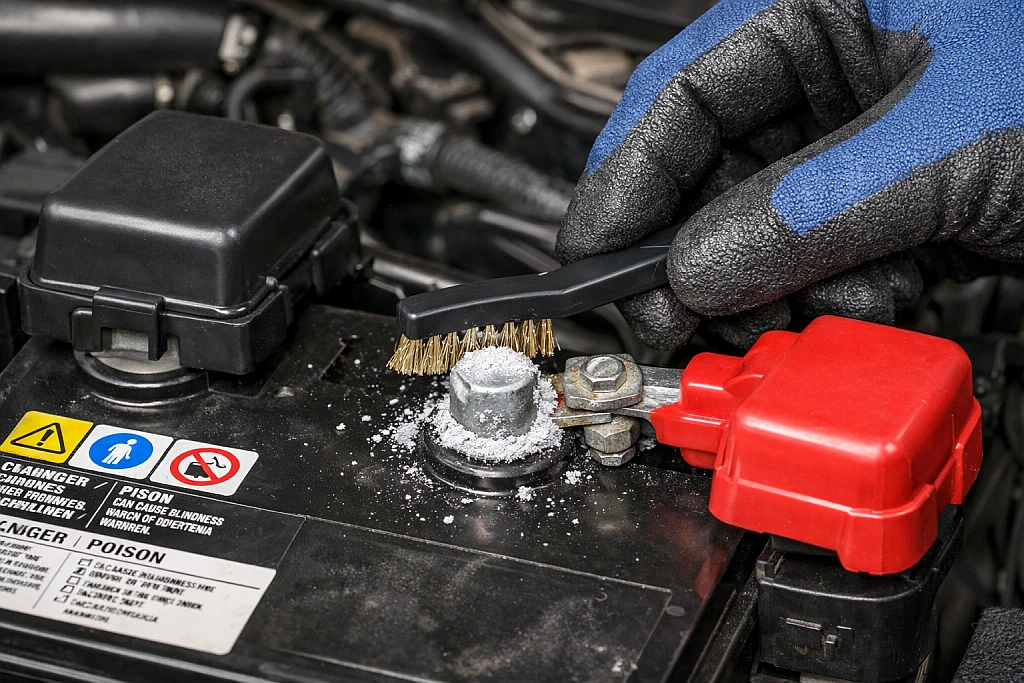
While not a fluid, battery maintenance is crucial and takes 2 minutes.
What to check:
- Terminals should be clean and tight
- No white/blue/green powder (corrosion)
- Cables firmly attached (shouldn’t wiggle)
- Battery case not cracked or bulging
- Battery hold-down bracket secure
If corroded:
- Disconnect battery (negative first, then positive)
- Mix baking soda and water into paste
- Scrub terminals with old toothbrush
- Rinse with water, dry completely
- Apply thin layer of petroleum jelly or terminal protector spray
- Reconnect (positive first, then negative)
- Tighten firmly
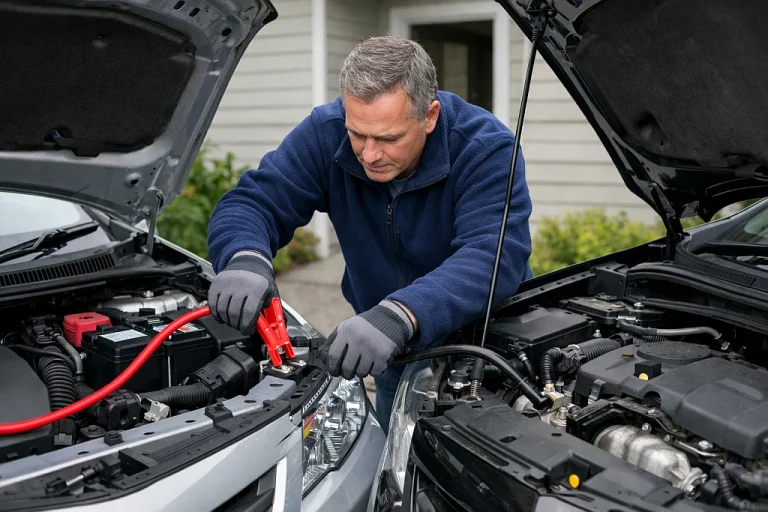
- If you discover your battery has low electrolyte and your car won’t start, you may need to know how to jump start your car safely before addressing the fluid issue.
Monthly Fluid Check Routine (10 Minutes)
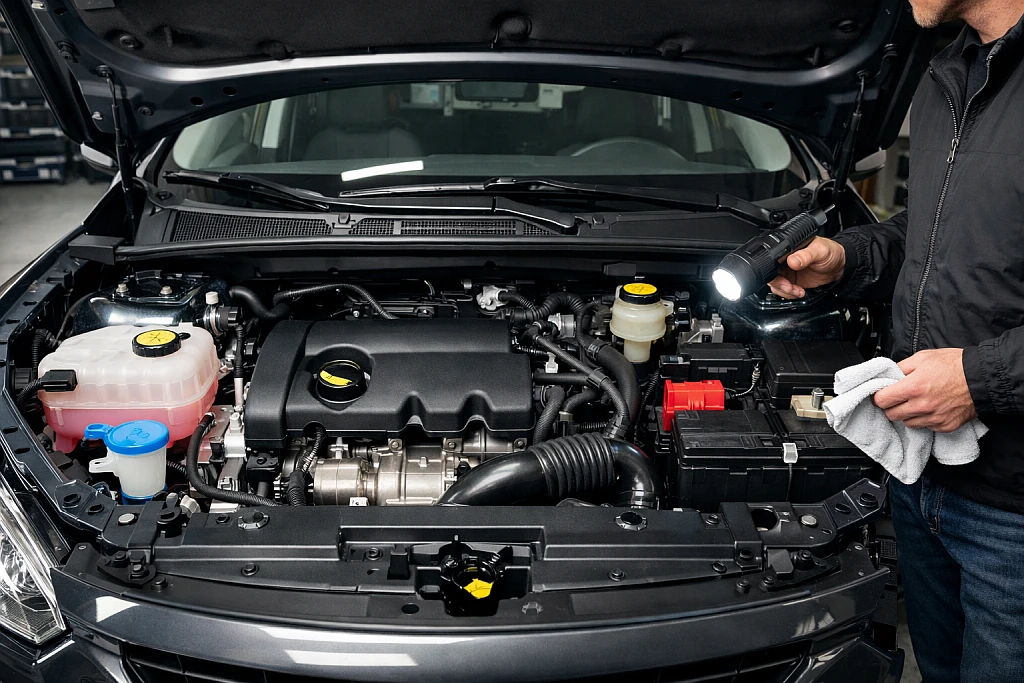
- Set calendar reminder for first Sunday of each month:
- Park on level ground, apply handbrake
- Turn off engine, let cool 10 minutes
- Open bonnet
- Check engine oil (2 min)
- Check coolant level (1 min)
- Check brake fluid (1 min)
- Check power steering fluid if applicable (1 min)
- Check washer fluid (1 min)
- Inspect battery terminals (1 min)
- Look for any leaks under car (1 min)
- Check tyre pressures while you’re at it (2 min)
- Total: 10 minutes monthly = prevention of expensive breakdowns
Pro tip:
Take a photo of your engine bay with bonnet open. Label the reservoir locations. Keep photo in phone for quick reference.
Frequently Asked Questions
Can I use water instead of coolant in an emergency?
In absolute emergency (overheating and nothing else available), you can add plain water to get you home. However, water alone provides no antifreeze protection (freezing risk in winter) and no corrosion inhibitors (damages cooling system). Replace with proper 50/50 coolant mix as soon as possible, preferably same day. Never drive long distances on water only.
How do I know which fluids my car needs?
Check your owner’s manual, it lists exact specifications for all fluids. Alternatively, reservoir caps often show fluid type. For oil, check the oil filler cap or dipstick. Most auto parts shops (Halfords, Euro Car Parts) have lookup tools where you enter registration number and they’ll tell you correct fluids. When in doubt, call your dealer’s parts department with VIN number.
What if I accidentally put the wrong fluid in?
Don’t start the engine. Wrong fluid can cause serious damage. Brake fluid in coolant system: needs complete drain and flush. Oil in coolant: potentially head gasket assumption, needs investigation. Coolant in oil: catastrophic, don’t run engine. Wrong brake fluid type (DOT 5 vs DOT 4): complete brake system flush required. Call breakdown service or mechanic before starting, prevention is cheaper than repair.
How often should fluids be completely replaced?
Engine oil: Every 10,000-12,000 miles or annually. Coolant: Every 2-5 years depending on type (check manual). Brake fluid: Every 2-3 years (absorbs moisture over time). Power steering: Every 50,000 miles or when dark/burnt. Washer fluid: Top up as needed, no replacement necessary. These are guidelines, severe use requires more frequent changes.
Is it normal for fluid levels to drop over time?
Slight drops are normal: Engine oil consumption (especially older engines): 1L per 1,000 miles can be acceptable. Brake fluid: Drops as pads wear (refills when new pads fitted). Coolant: Minimal drop over months is normal. However, rapid drops indicate leaks requiring immediate attention. Washer fluid obviously drops with use. If topping up monthly, investigate for leaks.
Can I check fluids when the engine is hot?
Engine oil: Some manuals specify warm engine check. Coolant: NEVER open when hot, pressurized boiling liquid can cause severe burns. Wait minimum 2 hours. Brake fluid: Check when cold. Power steering: Check specification in manual (some cold, some warm). Washer fluid: Anytime. When in doubt, wait for engine to cool completely, safer and more accurate readings.
What should I do if I find a puddle under my car?
Identify the fluid by colour and location: Clear water near exhaust = normal AC condensation. Green/pink/yellow under front = coolant leak (sweet smell). Dark brown/black under engine = oil leak. Red under front/middle = transmission or power steering leak. Clear under front corners = brake fluid (very serious). Brown with water = rusty coolant. Don’t drive with brake or major coolant leaks, call mechanic.
Conclusion
Checking your car’s five vital fluids monthly takes just 10 minutes and prevents thousands in repair costs. Engine oil, coolant, brake fluid, power steering fluid, and washer fluid, each plays a critical role in keeping your car running safely and reliably.
The process is straightforward: park on level ground, let the engine cool, locate each reservoir (consult your manual if needed), check levels against MIN/MAX marks, and top up with the correct fluid type when necessary. Pay attention to fluid colour and clarity, they tell you about contamination or degradation.
Set a monthly calendar reminder. Make it routine, like checking your phone. This simple habit catches problems early, a £5 bottle of coolant prevents a £1,500 head gasket repair, a brake fluid check ensures your family’s safety, and an oil level inspection protects a £3,000 engine.
Most drivers never look under their bonnet until stranded at the roadside. Don’t be most drivers. Ten minutes monthly gives you peace of mind, saves money, and keeps you safe. Your car will thank you with years of reliable service.