
How to Fall Asleep Fast: 10 Science-Backed Methods That Work
Wondering how to fall asleep fast? Lying awake at 2 AM, watching the minutes tick by, knowing you have to be up in four hours. We’ve all been there. The harder you try to fall asleep, the more awake you feel. Your mind races, your body tenses, and sleep feels increasingly impossible.
The good news? Falling asleep quickly isn’t about luck or natural talent – it’s about using scientifically proven techniques that work with your body’s biology. Whether you’re dealing with occasional insomnia or just want to fall asleep faster every night, these 10 methods can help you drift off in minutes instead of hours. If you’re struggling with long-term sleep issues, check our complete guide on how to fix your overall sleep schedule in 7 days.
These aren’t old wives’ tales or unproven tricks. Each method is backed by sleep research and has helped countless people fall asleep faster. Let’s get you sleeping quickly tonight.
Why You Can’t Fall Asleep (And Why That Makes It Worse)
Understanding why you can’t sleep helps you choose the right technique:
Racing thoughts:
Your mind won’t shut off, cycling through tomorrow’s tasks, past conversations, or worries. This mental activity keeps your nervous system activated.
Physical tension: Stress causes muscle tension throughout your body. You might not even realize you’re holding tension in your jaw, shoulders, or legs until you consciously check.
Sleep anxiety:
Worrying about not falling asleep creates a stress response that makes sleep even more difficult. This becomes a vicious cycle.
Hyperarousal:
Your sympathetic nervous system (fight-or-flight) is activated when it should be in parasympathetic mode (rest-and-digest). The techniques below help make this switch.
1. The 4-7-8 Breathing Method (Works in 2 Minutes)
Developed by Dr. Andrew Weil, this breathing technique is often called a “natural tranquilizer for the nervous system.” Harvard Medical School research shows controlled breathing techniques can activate the parasympathetic nervous system, promoting relaxation and sleep.
How to Do It:
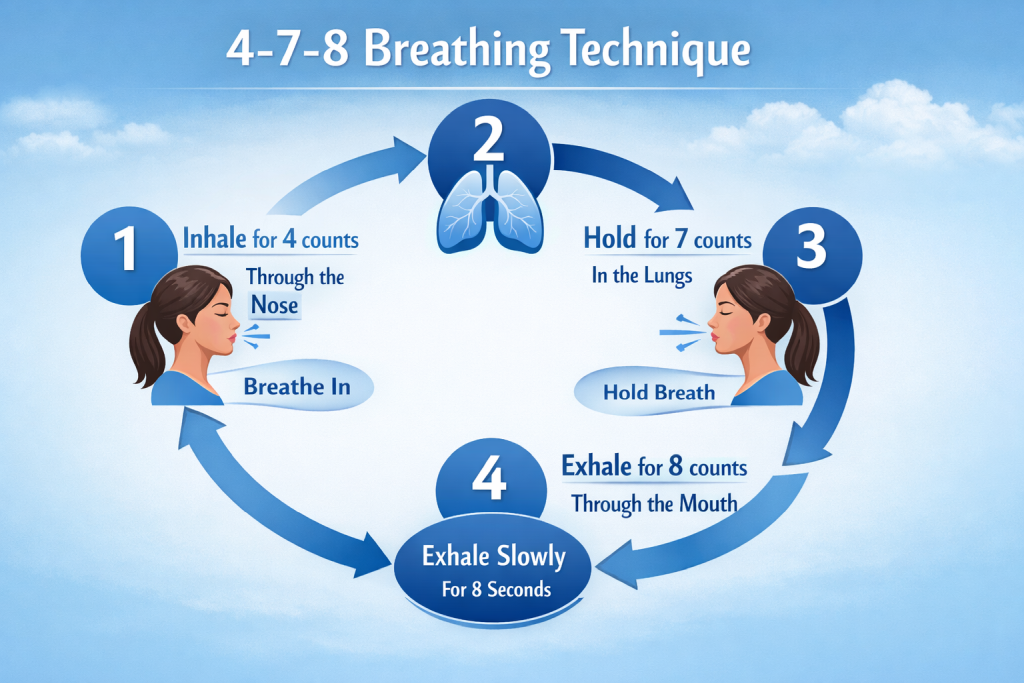
- Place the tip of your tongue against the ridge behind your upper front teeth (keep it there the whole time)
- Exhale completely through your mouth, making a whoosh sound
- Close your mouth and inhale quietly through your nose for a count of 4
- Hold your breath for a count of 7
- Exhale completely through your mouth, making a whoosh sound, for a count of 8
- This is one breath. Repeat the cycle 3 more times (4 total breaths)
Why it works:
The extended exhale and breath-holding increase carbon dioxide in your blood, which signals your body to relax. The rhythm and counting also distract your mind from racing thoughts.
Pro tip:
Don’t worry about the exact timing at first. Focus on the 4:7:8 ratio. With practice, you can slow the counts down for deeper relaxation.
2. Progressive Muscle Relaxation (PMR)
Most people hold physical tension without realizing it. PMR systematically releases tension throughout your entire body, often bringing sleep within 10-15 minutes
The Technique:
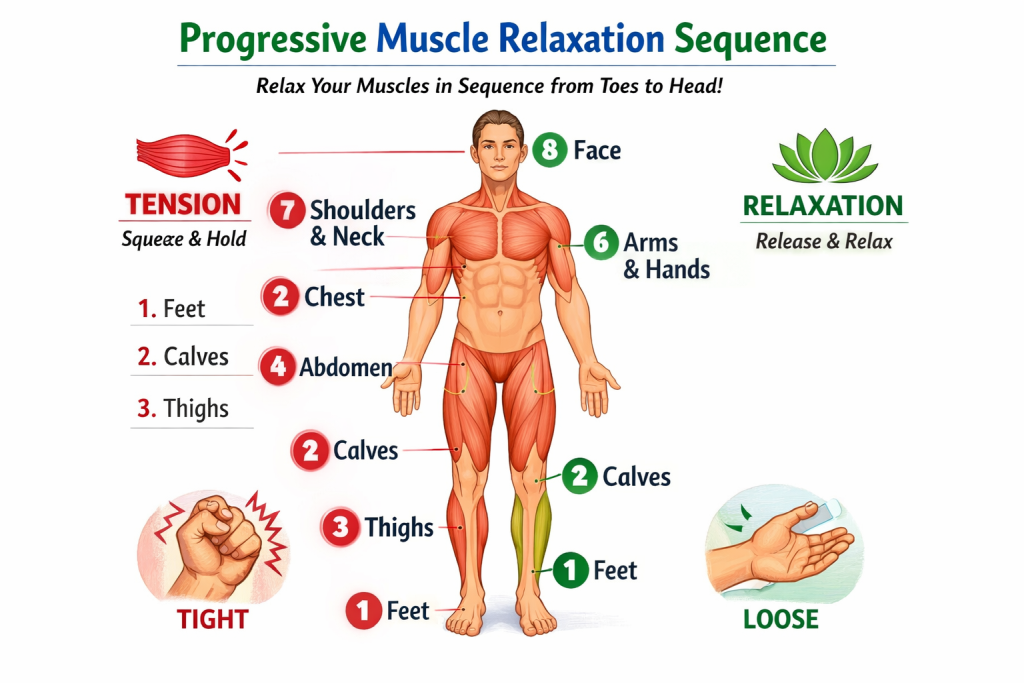
Starting at your toes and moving upward, tense each muscle group for 5 seconds, then release for 30 seconds before moving to the next group.
Sequence:
- Toes and feet: Curl toes tightly, hold, release
- Calves: Point toes toward shins, hold, release
- Thighs: Squeeze thigh muscles, hold, release
- Buttocks: Clench, hold, release
- Stomach: Pull belly button toward spine, hold, release
- Hands: Make fists, hold, release
- Arms: Tense biceps and forearms, hold, release
- Shoulders: Raise shoulders toward ears, hold, release
- Neck: Gently press head back into pillow, hold, release
- Face: Scrunch all facial muscles toward center, hold, release
After finishing the sequence, lie still and notice how relaxed your body feels. Most people drift off within minutes of completing PMR.
3. The Military Method (Used by U.S. Armed Forces)
Developed by the U.S. Navy Pre-Flight School, this method reportedly helps 96% of people fall asleep within 2 minutes after 6 weeks of practice. Even on your first try, it can significantly reduce the time it takes to fall asleep.
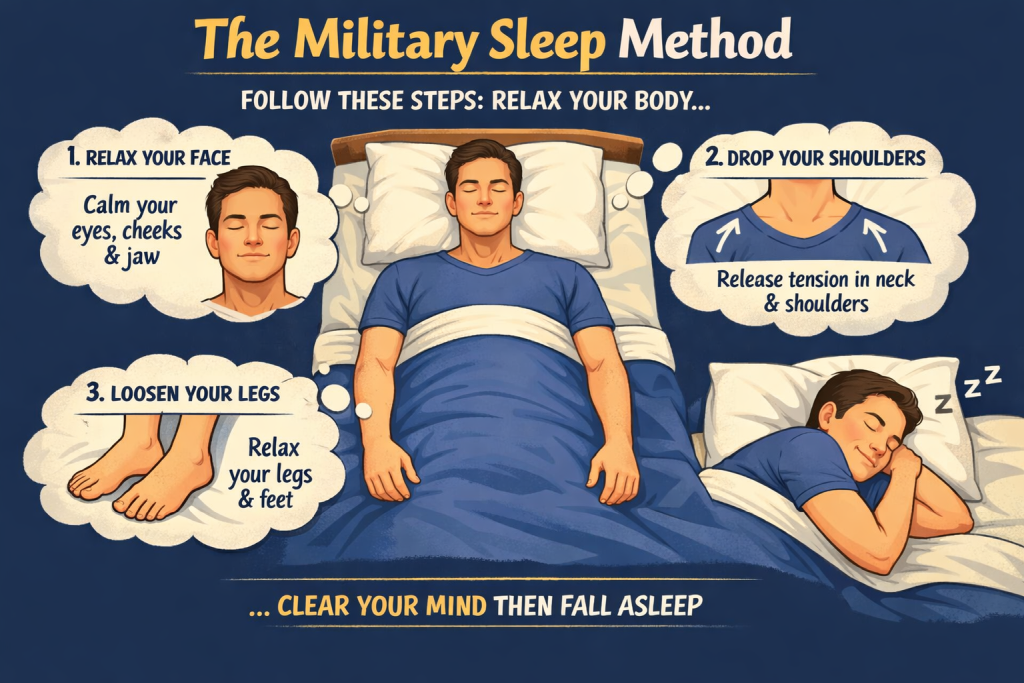
The 6-Step Process:
- Relax your entire face, including muscles inside your mouth and tongue. Let your jaw hang loose.
- Drop your shoulders as far down as they’ll go, releasing all tension. Follow with your upper and lower arm, one side at a time.
- Breathe out, relaxing your chest.
- Relax your legs, thighs, and calves in sequence.
- Clear your mind for 10 seconds by imagining a relaxing scene. Choose one: lying in a canoe on a calm lake under a clear blue sky, or lying in a black velvet hammock in a pitch-black room.
- If visualization doesn’t work, repeat “don’t think, don’t think, don’t think” for 10 seconds.
The key is practice. Military personnel train this method for weeks. Don’t give up after one try – it gets more effective each time.
4. Body Scan Meditation
Similar to PMR but without the tensing. Body scan meditation involves mentally “scanning” your body from toes to head, simply noticing sensations without judgment.
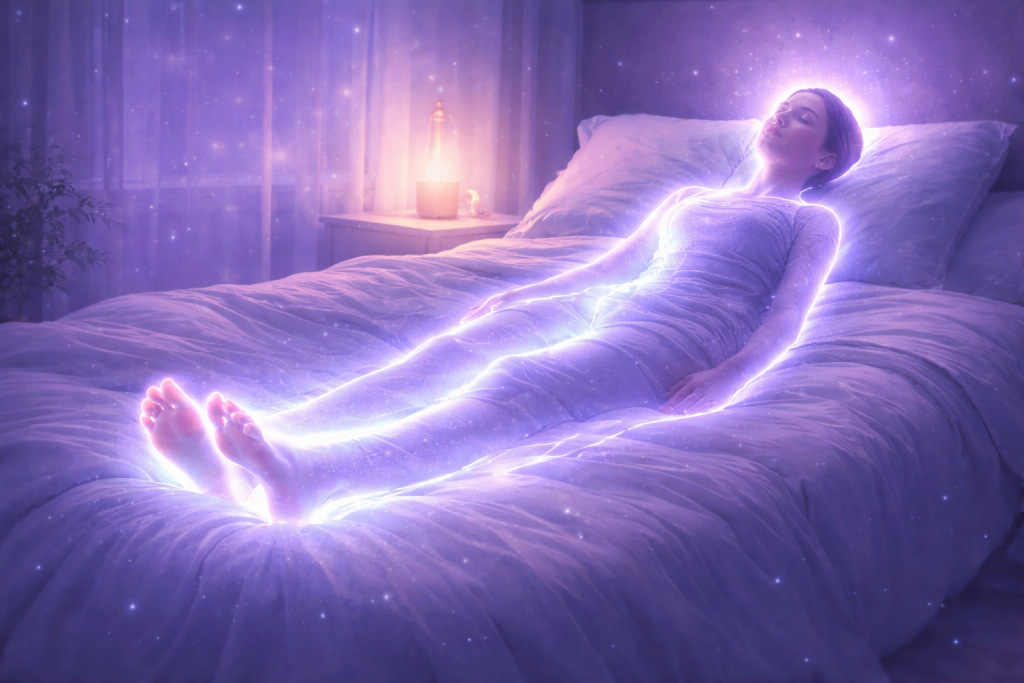
How to Practice:
- Lie comfortably in bed
- Take 3 deep breaths
- Bring awareness to your toes. Notice any sensations – warmth, coolness, tingling, or nothing at all
- Slowly move attention up through: feet, ankles, calves, knees, thighs, hips, stomach, chest, fingers, hands, arms, shoulders, neck, face, and scalp
- Spend 10-30 seconds on each body part
- If your mind wanders, gently return focus to the last body part you remember
Most people never make it to their head before falling asleep. The slow, methodical focus quiets mental chatter while relaxing the body.
5. The Reverse Psychology Method
Based on paradoxical intention therapy, this technique involves trying to stay awake instead of trying to sleep. It sounds counterintuitive, but it works by eliminating sleep anxiety.
How It Works:
- Lie in bed comfortably with eyes gently open
- Softly repeat to yourself: “I will stay awake. I will not fall asleep.”
- Try genuinely to keep your eyes open without straining
- Don’t check the clock or engage in stimulating thoughts
Why it works: Trying to fall asleep creates performance anxiety. Trying to stay awake removes that pressure, allowing your natural sleep drive to take over. Studies show this method reduces time to fall asleep by an average of 14 minutes.
6. Visualization and Mental Imagery
Your brain can’t tell the difference between real experiences and vividly imagined ones. Visualization engages your mind in a way that’s incompatible with racing thoughts.
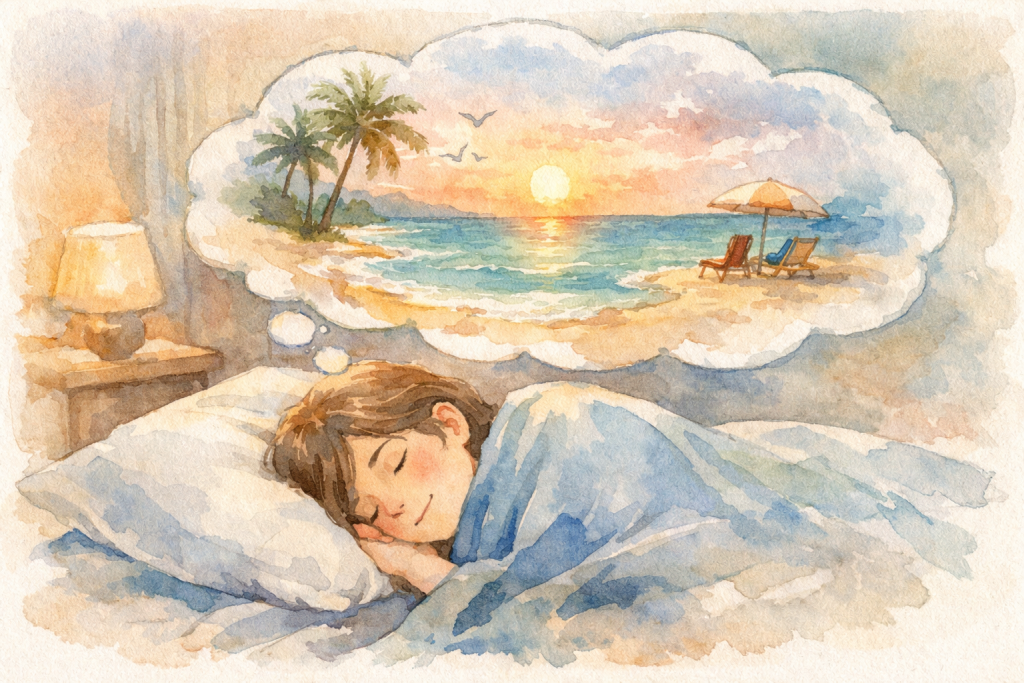
Effective Visualizations:
Walking through a peaceful forest:
Imagine the path beneath your feet, birds chirping, sunlight filtering through trees, the smell of pine. Add as much sensory detail as possible.
Floating on calm water:
Feel the gentle rocking, hear water lapping, see blue sky above. Let yourself drift.
Descending a staircase:
Each step takes you deeper into relaxation. Count backward from 100, one number per step. Most people are asleep before reaching zero.
Your favorite peaceful place:
A beach, mountain cabin, or childhood hideaway. Re-create it in vivid detail.
Pro tip:
Engage all senses – sight, sound, smell, touch, even taste. The more detailed your visualization, the more it absorbs your attention away from worries.
7. The Cognitive Shuffle (Mental Diversification)
Developed by cognitive scientist Dr. Luc Beaudoin, this technique prevents your brain from engaging in logical, problem-solving thought that keeps you awake.
How to Do It:
- Choose a random, emotionally neutral word (like “bedtime” or “curtain”)
- For each letter in the word, think of unrelated words starting with that letter and visualize them
- Example with “bedtime”: B – boat, banana, buffalo, beach… E – elephant, escalator, envelope… D – door, dolphin, desert…
- Visualize each item briefly (5-10 seconds) before moving to the next
- When you run out of words for a letter, move to the next letter
Why it works: The random, non-threatening imagery prevents your brain from engaging in logical thought patterns that require alertness. It mimics the incoherent imagery of falling asleep.
8. The Temperature Trick
Your body temperature naturally drops as you fall asleep. You can trigger this process manually to signal your body it’s time to sleep.
Methods:
Warm bath 60-90 minutes before bed: When you exit the warm bath, your body temperature drops rapidly, triggering sleepiness. Add 1-2 cups Epsom salt for extra relaxation.
Cool room:
Keep bedroom temperature between 65-68°F (18-20°C). Your body can’t fall asleep in a warm room.
Cold socks method:
Counterintuitively, wearing socks dilates blood vessels in feet, dissipating body heat and promoting sleep. Try it.
Stick one leg out:
Regulates temperature without getting fully cold. The foot is perfect for temperature regulation.
9. The 10-3-2-1-0 Formula
This technique structures your entire day to optimize nighttime sleep. Use it when nothing else seems to work.
The Formula:
10 hours before bed: No more caffeine
3 hours before bed: No more food or alcohol
2 hours before bed: No more work or mentally demanding tasks
1 hour before bed: No more screens (phones, TV, computer)
0: Number of times you hit snooze in the morning (wake immediately)
This formula creates ideal conditions for rapid sleep onset. Most people fall asleep within 10-15 minutes when following it consistently.
10. The Two-Part Counter Technique
When everything else fails and you’re still lying awake, use this emergency technique.
Part 1 – Get Out of Bed:
If you’ve been awake for 20 minutes, get out of bed. Lying awake creates a mental association between your bed and wakefulness – the exact opposite of what you want.
- Go to another room with dim lighting
- Do something boring (fold laundry, read a dull manual)
- No screens, bright lights, or stimulating activities
- Return to bed only when you feel genuinely sleepy (droopy eyes, yawning)
Part 2 – Counting with Breaths:
Once back in bed, count backward from 1000 by 7s, taking one breath per number. This is mentally demanding enough to prevent worry thoughts but boring enough to promote sleep. Most people are out before reaching 900.
What Doesn’t Work (Stop Wasting Your Time)
Counting sheep:
Research shows this is actually too boring and ineffective. Your mind wanders to worries.
Drinking alcohol:
While it makes you drowsy initially, alcohol disrupts REM sleep and causes early morning waking.
Checking your phone:
“Just a quick check” exposes you to blue light and stimulating content, both of which delay sleep by 30+ minutes.
Trying harder to sleep:
Effort creates tension. All these methods work because they redirect your focus away from trying.
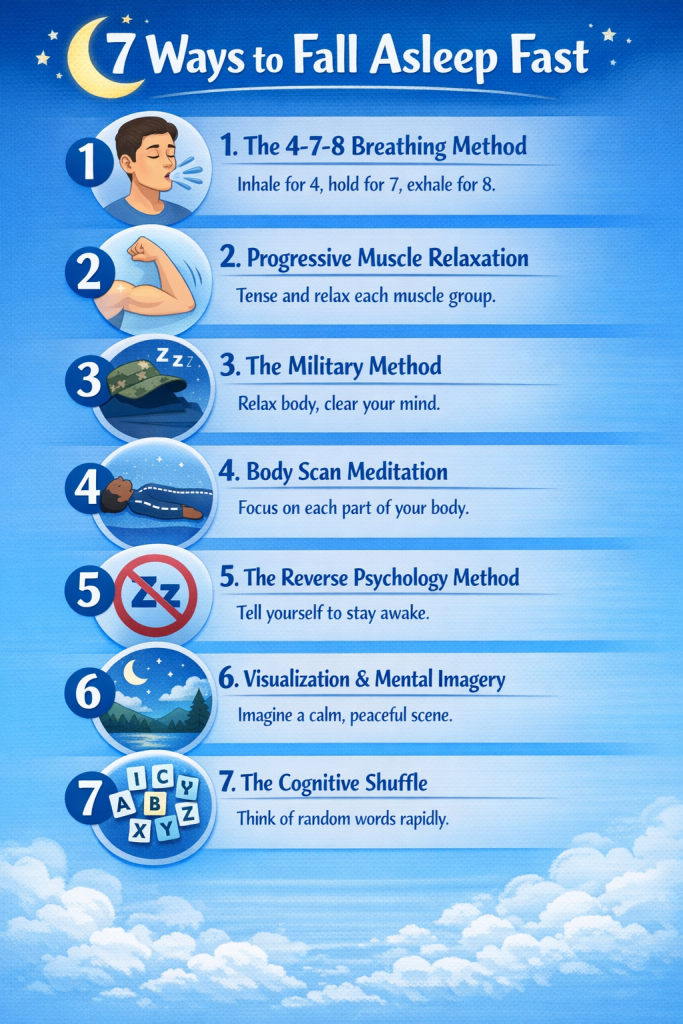
Which Method Should You Try First?
Start with the 4-7-8 breathing method – it’s quick, works immediately, and requires no preparation. If racing thoughts are your main issue, try the cognitive shuffle or visualization. For physical tension, choose progressive muscle relaxation or body scan meditation.
Give each technique at least 3-5 tries before deciding it doesn’t work. Your brain needs practice to learn new patterns. Most people find success by combining two methods – for example, 4-7-8 breathing followed by progressive muscle relaxation.
Frequently Asked Questions
How long should these techniques take to work?
Some techniques like 4-7-8 breathing can work within 2-5 minutes on your first try. Others like the military method become more effective with practice – expect noticeable improvements after 3-5 nights and optimal results after 2-3 weeks. If you’re still taking over 30 minutes to fall asleep after 2 weeks of consistent practice, you may have underlying sleep issues worth discussing with a doctor.
Can I use these methods for daytime naps?
Absolutely. The 4-7-8 breathing and military method work particularly well for quick naps. Keep naps under 20 minutes to avoid sleep inertia (grogginess upon waking). Set an alarm so you don’t worry about oversleeping, which can interfere with falling asleep. Progressive muscle relaxation might be too time-consuming for short naps but works great for longer rest periods.
What if I wake up in the middle of the night?
Use the same techniques to fall back asleep. The 4-7-8 breathing and body scan meditation work especially well for middle-of-the-night waking. If you’ve been awake for 20+ minutes, get out of bed following the two-part counter technique. Resist the urge to check your phone or the time – knowing how long you’ve been awake increases anxiety. Focus on rest rather than sleep; even quiet rest provides recovery.
Should I use sleep medications or supplements?
Try behavioral techniques first for at least 2-3 weeks before considering supplements. These methods address the root cause of sleep problems rather than masking symptoms. If needed, melatonin (0.5-3mg taken 30 minutes before bed) can help reset your circadian rhythm when combined with these techniques. Avoid over-the-counter sleep aids long-term as they can create dependency and reduce natural sleep quality. Always consult your doctor before starting any sleep medication.
Why do these techniques stop working sometimes?
Techniques can lose effectiveness if you practice them half-heartedly or let your mind wander to worries during the process. The key is genuine focus and engagement. If a method stops working, switch to a different one for a few weeks, then return to your original technique. Your brain adapts to patterns, so occasional rotation maintains effectiveness. Also check for new sources of stress or schedule changes disrupting your sleep.
Is it normal for my mind to wander during these exercises?
Completely normal. Everyone’s mind wanders, especially at first. The goal isn’t perfect concentration – it’s gently redirecting your attention back to the technique whenever you notice wandering. Each redirection strengthens your focus and relaxation. Think of mind-wandering as an opportunity to practice refocusing, not as failure. With time, you’ll maintain attention longer, but some wandering will always occur. That’s fine.
Can anxiety or stress prevent these methods from working?
Severe anxiety can make any sleep technique less effective, but these methods are specifically designed to counteract stress and anxiety. Start with the 4-7-8 breathing or progressive muscle relaxation – both directly calm your nervous system. If anxiety is chronic and severe, these techniques work best alongside therapy or professional treatment. Consider journaling worries before bed to externalize thoughts, then use these methods to relax your body and mind.
Conclusion
Falling asleep fast isn’t about luck or genetics – it’s a learnable skill. Each of these 10 techniques is backed by sleep science and has helped millions of people overcome insomnia and reduce the time it takes to fall asleep from hours to minutes.
Start tonight with the 4-7-8 breathing method. It’s simple, works quickly, and provides immediate results for most people. If your sleep problems persist beyond occasional difficulty falling asleep, these techniques work even better when combined with proper sleep hygiene and schedule consistency. For a complete approach to better sleep including wake times, light exposure, and bedroom optimization, read our guide on fixing your sleep schedule completely.
Remember that these are skills that improve with practice. Don’t give up after one night. Commit to using your chosen technique for at least one week, and you’ll likely see dramatic improvements in how quickly you fall asleep. Sweet dreams!